



Radish Genome Database
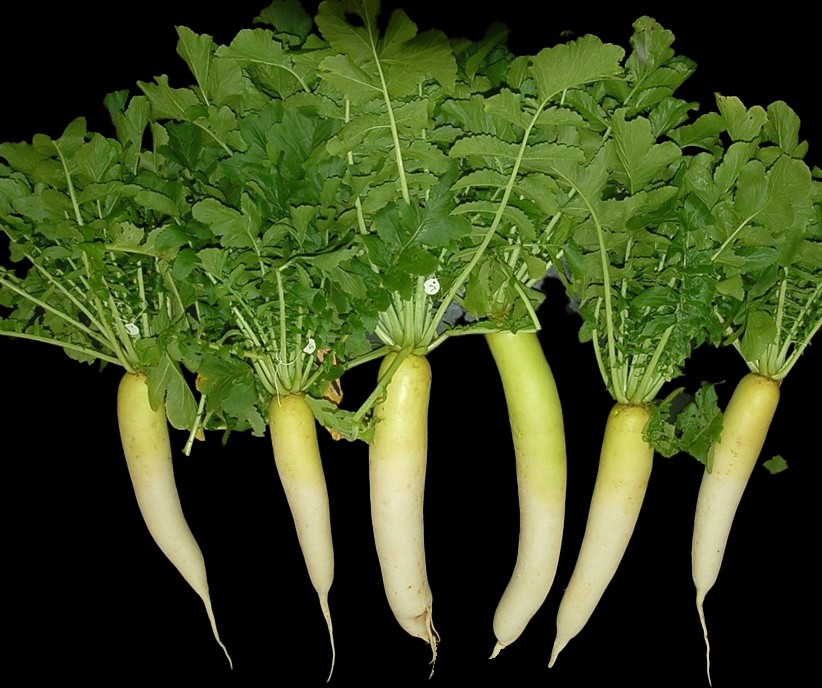
Aokubi daikon
Photo courtecy of Prof. Yuki Mitsui, Tokyo Univ. of Agric.
This Genome Browser is customized and maintained by NODAI Genome Research Center (NGRC) at Tokyo University of Agriculture.
We have released a major update to the Aokubi Raphanus sativus L. doubled haploid line reference genome. Compared with the previous short-read assembly (Rsativus_build1.00; Mitsui et al., 2015), the new version (Rsativus_build2.00; RSaok_v1; Masuda et al., manuscript under review) integrates Oxford Nanopore long-read sequencing and Bionano optical genome mapping to deliver a chromosome-scale assembly resolved into nine chromosomes.
Genome Browser (RSaok_v0.9 Draft)
Genome Browser (RSaok_v1)
Gene identifiers for nuclear genes were updated on October 5, 2026 to match the DDBJ/ENA/GenBank records (e.g. RSaok_1G000100). A table linking the previous identifiers to the current ones is available [RSaok_v1_old_browser_id_mapping.tsv(3.1 MB)]. Gene models on the former unplaced scaffold scf001, which was removed during DDBJ curation, are no longer included. Organelle gene models are shown as a separate track; they were predicted with miniprot and are not part of the DDBJ/ENA/GenBank annotation.
Aokubi daikon (Raphanus sativus L.)
Aokubi daikon (Raphanus sativus L. var. hortensis cv. Aokubi) is a long-rooted Japanese radish cultivar with roots approximately 30–40 cm in length and a distinctive green upper part of the root (the "neck"). Its name is derived from the Japanese words "ao" (blue/green) and "kubi" (neck). Aokubi is widely cultivated in East Asia and is the most widely grown daikon variety in Japan, used in traditional dishes such as simmered dishes (e.g., oden), pickles (e.g., takuan), and grated daikon (daikon oroshi). Radish is thought to have originated in the Mediterranean region and later spread to Asia, where it diversified into a wide range of morphotypes.
Assembly and annotation statistics
| Metric | Rsativus_build1.00 | RSaok_v1(Rsativus_build2.00) |
|---|---|---|
| Reference | Mitsui et al. (2015) Sci. Rep. 5:10835 | Masuda et al. (manuscript under review) |
| Accession | GCA_001047155.1 | DDBJ/ENA/GenBank AP048637–AP048728; figshare doi:10.6084/m9.figshare.32020035 |
| Cultivar / line | R. sativus L. var. hortensis cv. Aokubi doubled haploid line | R. sativus L. var. hortensis cv. Aokubi doubled haploid line |
| Sequencing platform | 454 + Illumina Hiseq 2000 (121.8x coverage total) | Oxford Nanopore PromethION (71.0 Gb, read N50 41.2 kb, 123x cov.) + Bionano Saphyr optical genome mapping |
| Total assembled size | 383.1 Mb | 476.1 Mb |
| Number of sequences | 40,123 | 92 (9 pseudochromosomes + 5 unplaced scaffolds + 76 unplaced contigs + mitochondrial genome (mt) +chloroplast genome (cp)) |
| Gap content | 31.9% | 0.8% (956 gaps) |
| pseudochromosomes | 9 pseudomolecules (partial; 179.8 Mb / 47% of assembly anchored via 1,384 markers) | 9 pseudochromosomes (98.2% of assembly anchored) |
| Contig N50 | 7.1 kb | 36.9 Mb (~5,200×) |
| Scaffold N50 | 138.6 kb | 52.2 Mb (~380×) |
| BUSCO (genome, brassicales_odb12) | C: 97.6% [S: 62.6, D: 35.0], F: 0.7, M: 1.8 | C: 99.2% [S: 60.6, D: 38.6], F: 0.0, M: 0.8 |
| LTR Assembly Index (LAI) | – | 19.9 |
| Telomeres | – | 17 of 18 chromosome ends (TTTAGGG repeats) |
| Centromeres | – | Predicted on all 9 chromosomes |
| Organelle genomes | not included | mt 244 kb (45% GC) + cp 153 kb (36% GC), both circular |
| Repetitive content | 36.68% | 61.5% |
| Protein-coding gene loci | 64,657 gene models (AUGUSTUS, Arabidopsis params, ab initio; RNA-seq used post-prediction for validation only) | 40,973 gene loci / 46,183 transcripts (BRAKER3 + TSEBRA, RNA-seq integrated as prediction hints; 46,183 mRNA transcripts) |
Technical Notes
*1 Contig N50 improvement: The Contig N50 improvement from 7.12 kb to 36.9 Mb (approximately 5,200-fold) reflects the resolving power of long-read sequencing.
*2 Repetitive content: Repetitive content increased from 36.68% to 61.5% because long-read assembly captured highly repetitive regions, such as centromeric repeats and large LTR-retrotransposon clusters (Gypsy: 29.90%, Helitron: 11.30%, Copia: 9.52%), —that were collapsed or missing in the short-read assembly; differences in repeat annotation pipelines (REPET and RepeatMasker in Mitsui et al. (2015); EDTA with DeepTE reclassification in this study) also contribute.
*3 Gene count comparison: The apparent decrease in reported gene numbers (64,657 → 40,973) reflects multiple factors. (i) Prediction pipeline: Mitsui et al. (2015) used AUGUSTUS alone with Arabidopsis training parameters for ab initio gene prediction; RNA-seq data was used post-prediction only for validation and annotation(cDNA hit coverage of predicted models). In contrast, Masuda et al. used BRAKER3, which integrates GeneMark-ETP, AUGUSTUS, and RNA-seq alignment evidence as prediction hints during gene model construction, with TSEBRA filtering to retain only high-confidence models. (ii) Assembly contiguity: in the fragmented build1.00 (N50 138 kb), single genes are often split across scaffolds and counted as multiple partial gene models. (iii) Repeat handling: more comprehensive repeat annotation (EDTA + DeepTE) in this study removes predictions originating from transposable element ORFs. The current count of 40,973 gene loci (46,183 mRNA transcripts; 4,567 loci with multiple isoforms) is consistent with related Brassicaceae genomes such as Brassica rapa (~41,000 gene loci).
Publication
- Yuki Mitsui, Michihiko Shimomura, Kenji Komatsu, Nobukazu Namiki, Mari Shibata-Hatta, Misaki Imai, Yuichi Katayose, Yoshiyuki Mukai, Hiroyuki Kanamori, Kanako Kurita, Tsutomu Kagami, Akihito Wakatsuki, Hajime Ohyanagi, Hiroshi Ikawa, Nobuhiro Minaka, Kunihiro Nakagawa, Yu Shiwa & Takuji Sasaki. The radish genome and comprehensive gene expression profile of tuberous root formation and development. Sci. Rep. 5, 10835 (2015).
- Goro Masuda, Akito Hosoi, Kenji Komatsu, Yuki Mitsui, Yuko Arai-Kichise, Asuka Kamio, Rahul Sk, Hiroto Sekitoh, Miho Ozeki, Takashi Matsumoto, Shunsuke Yajima, Tomomi Tadokoro Chromosome-scale reference genome assembly of an Aokubi Raphanus sativus L. doubled haploid line. (manuscript under review)
Download
*1 RSaok_v1_genome.fasta.gz is a bgzip-compressed version of the genome sequence deposited in figshare (https://doi.org/10.6084/m9.figshare.32020035), and RSaok_v1_gene_models.gff3.gz and RSaok_v1_TEanno.gff3.gz are coordinate-sorted, bgzip-compressed versions of the corresponding figshare files; their contents are identical. RSaok_v1_organelle_genes.gff3 contains the annotated genes of the mitochondrial and plastid genomes. The assembly and gene annotation are also available from DDBJ/ENA/GenBank under accession numbers AP048637–AP048728.
*2 RNA-seq reads from 14 tissues and developmental stages (DDBJ accessions DRR010353–DRR010355 and DRR014743–DRR014781; Mitsui et al., 2015) were mapped to RSaok_v1 with HISAT2 v2.2.1, and the alignments of the three replicates of each condition were merged.
Cite us
Please contact us (nodaigc[at]nodai.ac.jp) if you use data or information from this website. When using these data in publications or online materials, please cite our paper:
Masuda et al. Chromosome-scale reference genome assembly of an Aokubi Raphanus sativus L. doubled haploid line. Manuscript under review
and include a reference to this website:
https://www.nodai-genome.org/RSaok.html?lang=en .
Contact information
E-mail : nodaigc[at]nodai.ac.jp